
Wardrobes with LED lights: the UK buyer’s guide (2026)
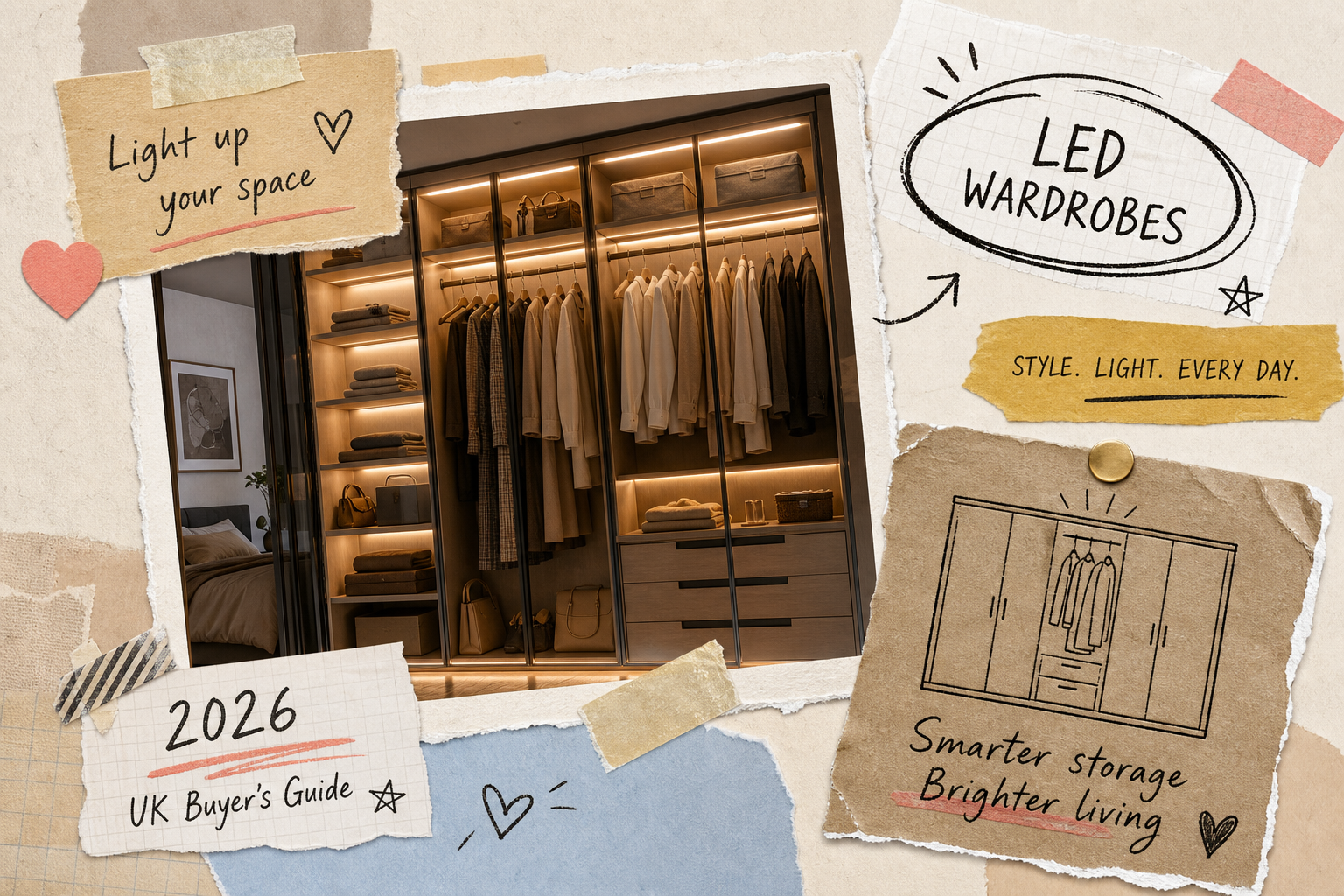
Wardrobe with LED lights UK: buyer’s guide (2026)
Picture this: it’s 7am, the bedroom curtains are still closed, and you pull what you’re certain is a navy blue shirt from the rail. You get to work, catch yourself in a mirror under fluorescent light, and realise it’s actually black. It’s a small thing, but it happens more often than it should, and the fix is simpler than most people realise. A well-positioned LED light inside your wardrobe changes the entire experience of getting dressed, and the benefits go well beyond avoiding colour mix-ups.
This guide covers everything you need to know before buying a wardrobe with integrated LED lighting in the UK. You’ll learn what the real functional benefits are, which specifications actually affect the result, and how to get quality wardrobe lighting solutions without a DIY project eating your weekend. UK retailers like Wardrobe House now include LED lighting as a ready-to-order upgrade on their fully assembled wardrobes, which means more buyers are getting integrated lighting without retrofitting anything.
Why a lit wardrobe makes a bigger difference than most people expect
The case for LED wardrobe lighting starts with a straightforward visibility problem. Many bedrooms rely on a single ceiling light or a bedside lamp, which often does little to illuminate the inside of a wardrobe. Add a closed door or deep shelving, and you’re essentially choosing your outfit by feel and guesswork, particularly during winter months when natural light can be limited well into the morning depending on where you are in the UK.
Seeing your clothes as they actually are
Colour accuracy is the benefit that gets overlooked most often. Standard bedroom lighting, particularly warm white bulbs in the 2700K range, can distort fabric tones. Lighting research and CRI guidance consistently show that low-CRI warm sources tend to make blacks appear as very dark navy, shift reds towards orange, and render cool greys warmer than they are. A dedicated LED inside the wardrobe, set to a neutral 3000, 4000K range with a CRI of 90 or above, shows you accurate fabric colours before you commit to the outfit. For anyone who buys clothes online (where screen colours rarely match reality) or owns a wardrobe deep enough to lose things in, this matters every single day. For broader storage advice, see Why UK Homes Never Have Enough Storage, And How to Fix It.
The daily routine impact
Beyond colour accuracy, an illuminated wardrobe simply makes mornings faster and less frustrating. You can spot items pushed to the back of the rail, read labels on folded shelves without squinting, and locate specific accessories without pulling half the wardrobe onto the bed first. Each one is a small gain. Across a year of daily use, removing that friction adds up to a genuinely better morning routine.
How integrated wardrobe lighting transforms your bedroom’s feel
LED wardrobe lighting does double duty. It illuminates the interior for practical use, but when the doors are open, it also casts a soft ambient glow into the room. That secondary effect is something a lot of buyers don’t anticipate until they experience it, and it changes how the bedroom reads as a space.
The ambient lighting effect you didn’t plan for
Even a modest LED strip inside a wardrobe creates a warm, considered glow that reads as intentional bedroom design rather than functional afterthought. In the evening, when main bedroom lights are dimmed down, an open illuminated wardrobe works like a subtle accent light source. Interior designers have used this deliberately in fitted wardrobe lighting projects for years, but with integrated lighting now available on freestanding wardrobes, the effect is accessible to anyone.
Why this matters more in smaller UK bedrooms
In compact UK bedrooms, where every visual trick matters, a lit wardrobe adds depth and draws the eye in a way that makes the room feel more considered. Mirrored wardrobe doors paired with internal LED lighting amplify this further, reflecting light back into the room and creating a sense of space that no amount of light-coloured paint can fully replicate. For most buyers, it’s often one of the more cost-effective visual upgrades available in a bedroom, and it requires no structural work at all.
The specs that actually matter when comparing LED wardrobe lighting
The lighting specifications attached to wardrobe product listings can look technical and intimidating, but most of the detail is irrelevant to the buying decision. Two specs matter above almost everything else, and one more becomes relevant when you’re choosing between power sources.
Lumens and colour temperature: the two specs to prioritise
Brightness, measured in lumens, should match the size of your wardrobe. A standard double wardrobe needs roughly 200, 400 lumens for even, shadow-free coverage across the interior. Go too low and you get dim corners; go excessively high and you get glare. Colour temperature is equally important: the research-backed recommendation for closet lighting in the UK lands in the 3000, 4000K range, with 4000K commonly cited as optimal. For practical guidance on recommended closet lighting approaches, see this closet lighting guide. Pair that with a CRI of 90 or above and you get accurate colour rendering without the harshness of cool white or the tonal distortion of warm white. Many budget wardrobes with built-in LEDs omit CRI and colour temperature specifications altogether, which helps explain why lighting quality can vary so dramatically between products at similar price points.
Power source and sensor options
Battery-powered strips are easy to fit and require no wiring, but they dim over time. Battery runtimes vary widely, many strips need attention within a few months, while some models can last closer to a year depending on usage. Mains-connected LEDs are brighter, more consistent, and cost almost nothing to run. Motion or PIR sensors are worth considering: they activate when you open the wardrobe doors and switch off automatically afterwards. That said, performance depends on sensor placement and hold-time settings, so confirm these are adjustable when buying, poorly configured sensors can trigger late or fail to shut off promptly. If you prefer compact off-the-shelf fixtures rather than full integrated systems, you might also look at options such as the Pair of Led Lights 20cm for smaller applications.
Why choose a wardrobe with LED lights in the UK: built-in vs DIY strip lights
There are two routes to a lit wardrobe: buy one with integrated LED lighting already built in, or add aftermarket strip lights to an existing wardrobe yourself. Both can work, but they differ considerably in effort, finish quality, and long-term reliability.
What retrofitting strip lights actually involves
Adding LED strips to an existing wardrobe is a viable DIY project, but it’s not as straightforward as peel-and-stick. You need to measure the interior runs, source a compatible 12V or 24V driver, route cables neatly using cable ducts, and position the sensor so it actually triggers on door opening rather than random movement. If there’s no socket within reach, you’ll need an electrician for the mains connection. Budget £50, 150 for a reasonable mains setup with decent components, and add £150, 400 if you bring in a professional to wire it properly; for current benchmarks on electrician hourly rates in the UK see a recent guide. That’s before you factor in the time spent measuring, ordering, and fitting.
Why factory-integrated lighting wins on aesthetics and practicality
Integrated LED lighting, fitted as part of the wardrobe’s original design, sits flush with the interior, uses fixtures sized for the actual dimensions, and arrives working from day one. Wardrobe House includes LED lighting as an optional upgrade across their sliding and hinged wardrobe range. Because every wardrobe is delivered fully assembled and built in your room by a specialist two-person team, the lighting is already in place and operational the moment the job is done. There’s no wiring to conceal, no sensor to reposition, and no follow-up visit from a trades person to sort out what the first visit missed.
Energy efficiency and long-term running costs in UK homes
The practical question most buyers forget to ask is what running wardrobe LED lighting actually costs over time. The answer genuinely surprises most people, and it makes the case for integrated lighting even stronger.
The real cost of LED wardrobe lights per year
At 2026 UK electricity rates, a 10W LED wardrobe strip costs approximately 0.24 pence per hour to run. Used for one hour daily via a motion sensor, that’s under £1 per year. Even at three hours of daily use, you’re looking at £2, 4 annually. Compared to traditional bulb-based closet lighting, LEDs use up to 80% less energy and last significantly longer. For a clear breakdown of running costs and typical household examples, see this cost guide on how much LED lights cost to run. Quality LED strips typically carry a rated lifespan of 25,000, 50,000 hours depending on the product; for manufacturer-backed details on strip lifespan see how long LED strip lights last. At typical wardrobe usage of one to three hours a day, even a mid-range 25,000-hour strip translates to more than two decades of reliable light before replacement becomes necessary.
Why this makes integrated LED a smarter long-term choice
When you factor in negligible running costs, zero maintenance requirements, and the absence of any retrofitting expense, the total cost of ownership for a wardrobe with built-in LED lighting is lower than it appears at first glance. The upfront premium for an upgrade that removes an ongoing DIY problem, costs almost nothing to run, and lasts decades is, for most buyers, a straightforward calculation.
What to look for when buying a wardrobe with LED lights in the UK
With the technical side covered, the buying decision comes down to a few practical checks. Getting these right ensures the lighting actually delivers what you’re expecting in your specific bedroom.
Match wardrobe size to lighting coverage
Confirm that the LED lighting covers the full interior of the wardrobe, not just a single strip near the top of the doors. Larger wardrobes at 200cm and above need more than one point of light to avoid shadowed corners at the back of the rail or lower shelving compartments. Ask specifically whether the lighting covers hanging rails, shelves, and any internal drawers or additional compartments, this varies significantly between products even at similar price points.
Where to buy and what to expect at different price points
Budget options from general furniture retailers often include low-CRI LEDs and battery-powered strips that look underwhelming in practice, particularly once the battery begins to dim after a few months of use. Mid-range and premium options give you proper integrated wardrobe lighting solutions as part of a fully built product. Wardrobe House offers LED lighting upgrades across a range of sliding and hinged wardrobes in multiple sizes and finishes, from White Matt and Grey Matt through to Oak Shetland, Oak Artisan, and Oak Sterling. With free mainland UK delivery, professional in-room assembly included as standard, and a 14-day money-back guarantee, the convenience factor alone justifies the step up in price for most buyers who’ve been down the flat-pack route before. For a practical checklist to avoid common pitfalls, download the expert fit guide: Avoid the 5 Most Common Wardrobe Buying Mistakes, Download Our Expert Fit Guide.
The bottom line on lit wardrobes
Dark wardrobes are one of those daily inconveniences that most people accept without realising there’s a simple, permanent fix. LED wardrobe lighting delivers accurate colour rendering for your morning routine and adds ambient character to the bedroom, all at negligible running cost. The only real decision is whether to retrofit or buy integrated from the start.
The case for integrated lighting is straightforward: better finish, no installation effort, and a working result from the moment your wardrobe is built. Wardrobe House makes this easy, with LED upgrades available across their ready-to-order range and every wardrobe arriving already assembled in your room by a specialist team. No trailing wires or strip lights peeling off six months later.
Measure your space, decide on your finish, and choose a wardrobe with LED lighting built in rather than bolted on afterwards. It’s the kind of decision that takes five minutes to make and saves you a weekend of DIY every time you revisit it.